Kansas Bradford pear removal is becoming a practical homeownership issue as mature trees develop weak branch unions, split during storms and spread into surrounding landscapes. A tree that once provided quick shade and spring flowers may eventually threaten the roof, driveway, utility lines or nearby structures.
Removal should not begin with a chainsaw and end with an empty space. Homeowners need to confirm the tree’s identity, evaluate its condition, plan safe access, prevent regrowth and select a replacement that can handle the property’s soil, available space and Kansas weather.
Why Bradford Pear Trees Became Common
Bradford pear is a cultivated variety of Callery pear. It became popular in residential developments because it grew quickly, produced white spring flowers and developed a symmetrical shape when young.
Those qualities made it attractive for front yards and street plantings. Unfortunately, the tree’s rapid growth can conceal structural weaknesses.
Many Bradford pears develop several upright branches from a narrow area of the trunk. As those branches increase in size, the connections between them may remain weak. Wind, ice or the weight of the canopy can then cause a major section to separate.
The problem may not become obvious until the tree is mature and large enough to damage something when it fails.
Why Kansas Bradford Pear Trees Create Concern
Kansas properties regularly experience strong winds, thunderstorms, hail, ice and rapid weather changes. These conditions can expose weaknesses in mature trees.
Bradford pears can present several overlapping concerns:
- Closely spaced branches may split at narrow attachment points.
- Dense canopies can catch substantial wind.
- Ice can add weight to already weak limbs.
- Broken sections can expose the remaining trunk to decay.
- Fruit can spread Callery pear seedlings beyond the original yard.
- Volunteer trees may form dense, thorny growth in unmanaged areas.
- Surface roots and shade may interfere with surrounding landscaping.
Kansas Forest Service includes a Callery Pear Buyback Program among its current initiatives. Participating events encourage property owners to remove invasive Callery pear trees and may offer a native replacement tree. Availability depends on the location, event dates and program requirements, which homeowners can check through the Kansas Forest Service programs page.
Confirm the Tree Before Planning Removal
Bradford pear is often used as a general name for ornamental Callery pear cultivars, but homeowners should confirm what is growing on their property.
Common characteristics include:
- White flowers appearing early in spring
- Glossy, rounded or teardrop-shaped leaves
- Red, orange or purple fall color
- Several steeply upright branches
- Small, hard fruit
- A compact or oval canopy
- Gray-brown bark that becomes more textured with age
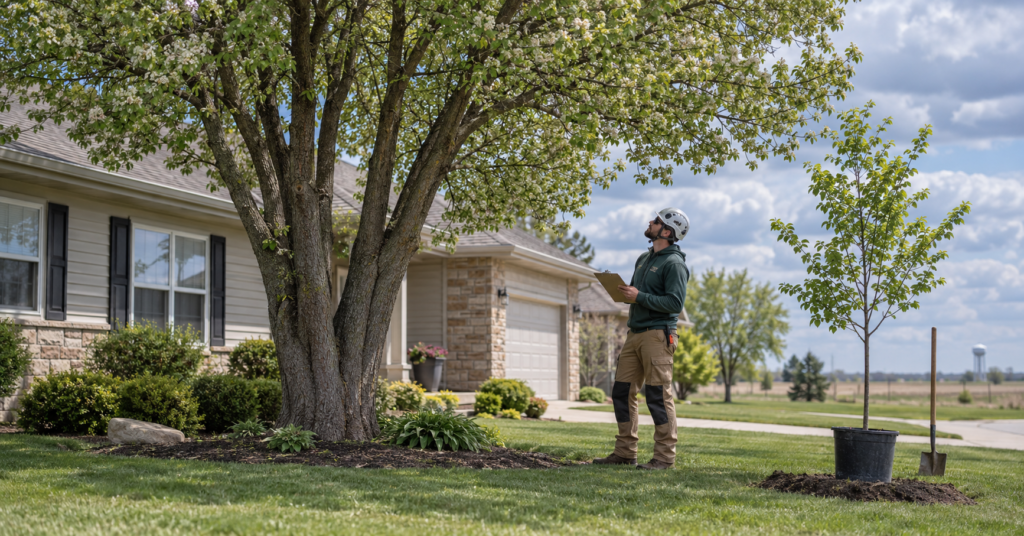
Other flowering trees can look similar from a distance. A local extension office, certified arborist or qualified tree professional can help identify the species before removal.
Correct identification is particularly important when applying for a buyback event or choosing a replacement with similar ornamental features.
Warning Signs That Require Prompt Attention
Not every Bradford pear needs to be removed immediately, but certain conditions justify a professional assessment.
A crack where major trunks meet
A visible opening between two large stems may show that the connection is beginning to separate. Fresh wood, peeling bark or movement during wind can indicate an active failure.
A large section has already broken
Loss of one major branch can leave the canopy unbalanced. It may also create an extensive wound that the tree cannot effectively close.
Branches extend over the house
A weak limb above a roof, bedroom, garage or electrical service creates more serious consequences than a similar limb over an open lawn.
The trunk contains cavities or decay
Soft wood, fungal growth, hollow areas and loose bark can indicate internal deterioration. The exterior may not reveal the full extent of the problem.
The tree leans or the soil is lifting
A recent change in lean, exposed roots or soil movement around the base can suggest instability. Keep people away from the potential fall area and request an urgent assessment.
Storm damage remains suspended in the canopy
Broken branches can remain caught above the ground. These limbs may fall without warning and should not be pulled down from underneath.
Pruning Versus Complete Removal
Corrective pruning can improve the structure of a young tree, but pruning cannot reverse every defect in a mature Bradford pear.
A limited pruning plan may be reasonable when:
- The tree is young and structurally sound.
- Defective branches can be removed without destroying the canopy.
- No major trunk union is separating.
- The tree has enough clearance from buildings and utilities.
- A qualified professional believes risk can be managed.
Removal may be more practical when:
- Several major stems originate from one weak junction.
- Large branches have repeatedly failed.
- Decay is present in the trunk or main unions.
- The tree threatens an occupied structure.
- Previous topping or improper pruning damaged its form.
- Retaining it would require frequent, expensive intervention.
- The homeowner wants to prevent further invasive spread.
Topping the tree is not a dependable compromise. Cutting large branches back to stubs can stimulate weak new growth, create decay points and leave the tree with an unnatural structure.
Evaluate What the Tree Could Hit
Risk depends on both the likelihood of failure and the consequences of whatever the tree may strike.
Before deciding how quickly to act, identify everything within reach of the trunk and major limbs:
- The house and attached garage
- Neighboring structures
- Vehicles and parking areas
- Fences and gates
- Public sidewalks
- Streets and alleys
- Play areas
- Utility lines
- Air-conditioning equipment
- Irrigation systems
- Sheds and detached buildings
A compromised tree beside an unused section of a large rural property presents a different risk from one leaning over a child’s bedroom.
Take photographs from several directions and record visible defects. Those records can help an arborist prepare an estimate and allow the homeowner to monitor any change while removal is being scheduled.
Check Local Rules Before Removing the Tree
Kansas does not have one statewide residential tree-removal procedure that applies identically to every property. Requirements may depend on the city, county, subdivision and location of the tree.
Before work begins, determine whether:
- The city requires a permit for certain trees.
- The tree is located in a public right-of-way.
- A homeowners’ association requires approval.
- The property lies within a historic district.
- Local rules regulate debris placement or collection.
- A shared boundary makes ownership uncertain.
- Nearby power lines require utility coordination.
A tree located between a sidewalk and street may not belong exclusively to the adjacent homeowner. Contact the appropriate municipal forestry or public works department before authorizing its removal.
Trees near property lines can also create disputes. A survey or professional legal advice may be necessary when ownership is unclear.
Property owners dealing with trees near public infrastructure may find similar documentation principles in PropertyTale’s guide to NYC sidewalk tree damage, although Kansas municipalities follow their own rules.
Keep Tree Work Away From Utility Lines
A tree does not have to touch a power line to create an electrical hazard. Branches, tools, ladders and lifting equipment can enter an energized area unexpectedly.
Homeowners should not attempt to remove a Bradford pear near overhead electrical conductors. Contact the utility or hire a properly qualified tree professional who understands electrical-clearance requirements.
Underground services also require attention. Stump grinding and replacement planting can interfere with:
- Gas lines
- Electric service
- Water lines
- Sewer laterals
- Communications cables
- Irrigation pipes
Request utility marking before excavation or stump grinding. Private lines, such as irrigation or power running to a detached building, may require separate locating arrangements.
Compare Tree-Removal Estimates Carefully
The lowest quoted price may not cover everything required to restore the yard.
Ask each contractor whether the estimate includes:
- Complete tree removal
- Controlled lowering of large limbs
- Protection for roofs and pavement
- Stump grinding
- Removal of surface roots
- Wood and debris hauling
- Final cleanup
- Soil or grinding-hole backfill
- Permit assistance
- Traffic or sidewalk control
- Proof of insurance
Also confirm how lawn damage will be handled if heavy equipment must cross the property.
A clear written scope makes estimates easier to compare. It also prevents disagreement about whether the stump, logs or wood chips will remain after the crew leaves.
Avoid High-Risk DIY Removal
A small sapling in an open yard may be manageable with appropriate tools and knowledge. A mature Bradford pear is different.
Its branch structure can react unpredictably when weight is removed. A cracked union may release while someone is climbing, cutting or pulling a limb. Ropes attached without proper rigging can redirect a falling section toward the house or the person performing the work.
Professional assistance is especially important when:
- The tree requires climbing.
- A ladder or aerial lift would be needed.
- Limbs extend above a structure.
- The trunk is split or decayed.
- Electrical lines are nearby.
- The fall area crosses a boundary or public space.
- The homeowner cannot keep others away from the work zone.
Protective equipment does not compensate for an unsafe removal plan.
Plan for the Stump and Possible Regrowth
Cutting down the visible tree does not always complete the job. Callery pear roots and stump tissue may produce new shoots.
Homeowners should decide whether to:
- Grind the stump below grade
- Remove accessible roots
- Monitor the area for sprouts
- Treat regrowth using an appropriate control method
- Delay replanting until the site is ready
- Add clean soil after chips settle
Large amounts of fresh wood chips mixed into the planting area can affect soil conditions and settling. Do not place the replacement tree directly into a deep pocket of loose grinding debris.
The final planting location may need to shift away from the old stump, underground utilities or compacted soil.
Document the Tree Before and After Removal
Homeowners should keep a basic record of the project, particularly when the tree was near a structure or removal followed storm damage.
Useful records include:
- Dated photographs of the full tree
- Close images of cracks and decay
- The professional assessment
- Municipal or HOA approval
- Contractor estimates
- Proof of insurance
- The signed work order
- Final photographs
- Payment records
- Replacement-tree information
If a storm damages the tree or another structure, contact the insurer before assuming that removal or repairs are covered. Homeowners insurance may treat emergency storm damage differently from preventive removal or ordinary maintenance.
Choosing a Replacement Tree for Kansas
The best replacement is not simply another fast-growing ornamental tree. It should be selected for the property’s conditions and the space available at maturity.
Evaluate:
- Expected height and canopy width
- Distance from the house
- Clearance from power lines
- Soil drainage
- Available sunlight
- Exposure to wind
- Drought tolerance
- Rooting space
- Seasonal appearance
- Maintenance requirements
- Resistance to locally important pests and diseases
Kansas conditions vary considerably across the state. A species that performs well in the wetter eastern region may not be equally suitable for a dry, exposed site farther west.
Kansas Forest Service emphasizes that successful establishment begins with proper selection and provides regional resources through its recommended-tree and community forestry programs. K-State Research and Extension also publishes a Recommended Trees for Kansas guide.
Replacement Trees Worth Evaluating
A suitable choice depends on the exact site, but Kansas homeowners may discuss the following possibilities with local forestry or extension professionals.
Eastern redbud
Eastern redbud offers spring flowers and a smaller mature form than many shade trees. It may work where homeowners want ornamental interest without an enormous canopy.
Serviceberry
Serviceberry provides spring flowers, fruit and fall color. Site conditions and the chosen variety should be checked carefully.
Bur oak
Bur oak can tolerate challenging conditions and develop into a substantial shade tree. It needs enough room for its mature canopy and root system.
Chinkapin oak
Chinkapin oak can provide long-term shade and strong landscape value when planted in a suitable location.
American linden
American linden develops into a large shade tree and should be reserved for properties with adequate overhead and underground space.
Kentucky coffeetree
Kentucky coffeetree can tolerate urban conditions and offers a distinctive branching structure. Homeowners should evaluate cultivar characteristics and mature size.
This is not a universal planting list. Soil, region, water availability and placement should guide the final decision.
Do Not Recreate the Same Hazard
Replacement planning should include enough distance from buildings and utilities to accommodate the tree’s mature dimensions.
Avoid planting:
- Directly beneath power lines
- Too close to the foundation
- Beside a narrow driveway where branches will require repeated cutting
- Over sewer or utility routes
- In a drainage low point unsuitable for the species
- Where roots have almost no uncompacted soil
- In the exact center of an old stump cavity without site preparation
Small nursery trees can make large future conflicts difficult to imagine. Use mature measurements, not the dimensions shown at the time of purchase.
Establish the Replacement Correctly
A well-selected tree can still fail if planted too deeply or neglected during establishment.
The root flare should remain visible near the soil surface. The planting hole should generally be wider than the root mass rather than unnecessarily deep. Remove packaging materials as recommended, backfill appropriately and avoid piling mulch against the trunk.
New trees require consistent moisture during establishment, but the amount should respond to soil drainage, rainfall and species requirements. Continually saturated soil can be as harmful as drought.
Inspect the tree periodically for:
- Leaning or instability
- Trunk damage
- Girdling ties
- Mulch against the bark
- Broken young branches
- Animal damage
- Drought stress
- Poor drainage
Early structural pruning can encourage better branch spacing and reduce the likelihood of recreating the defects associated with the removed Bradford pear.
Apply for a Callery Pear Buyback Event
Kansas Forest Service’s buyback events may allow qualifying participants to receive a native replacement after removing a Callery pear.
Requirements can differ by event. A homeowner may be asked to provide:
- Proof that the removed tree was a Callery pear
- A before photograph
- An after photograph
- The property address
- Registration before a deadline
- Attendance at a designated distribution event
Do not remove a tree solely on the assumption that a free replacement will be available. Confirm the current event location, eligibility rules and tree availability first.
Even when a buyback is unavailable, the program’s existence shows why replacement with a more appropriate species is preferable to planting another Callery pear cultivar.
Kansas Bradford Pear Homeowner Checklist
Before removal:
- Confirm the tree’s identity.
- Photograph its condition.
- Check for cracks, decay and previous failures.
- Identify buildings, utilities and public areas within reach.
- Verify ownership and local requirements.
- Request professional estimates.
- Confirm what happens to the stump and debris.
- Check current buyback opportunities.
- Select a replacement based on mature size and site conditions.
After removal:
- Inspect the area for property damage.
- Retain invoices and final photographs.
- Watch the stump and roots for regrowth.
- Prepare the planting area properly.
- Locate underground utilities before planting.
- Water and monitor the replacement during establishment.
- Begin structural pruning while the new tree is young.
Frequently Asked Questions
Is every Bradford pear in Kansas dangerous?
No. Risk depends on the tree’s structure, condition, size and surroundings. However, Bradford pears are known for weak branch unions and invasive spread, so mature trees should be inspected rather than assumed to be safe.
Can a split Bradford pear be repaired?
Some limited defects may be managed by a qualified arborist, but a major separation can leave the tree structurally compromised. Cabling or pruning is not appropriate for every tree, and the cost should be compared with complete removal.
Should a healthy Bradford pear still be removed?
A homeowner may choose preventive removal because of its location, invasive behavior or long-term structural concerns. The decision is easier when the tree threatens a structure or when a replacement can be established before failure occurs.
Does Kansas offer free replacement trees?
Kansas Forest Service supports Callery pear buyback events where eligible participants may receive native replacements. Events, locations and requirements change, so homeowners must check the current program details.
Will the Bradford pear grow back after cutting?
New shoots may emerge from the stump or roots. Stump grinding does not guarantee that every root is removed, so the area should be monitored for regrowth.
Can the replacement tree go in the same location?
It may be possible, but the old stump, remaining roots, grinding debris, soil condition and utility locations must be considered. Moving the planting site a short distance may produce better establishment.
Is storm-related removal covered by homeowners insurance?
Coverage depends on the policy, cause of damage and whether a covered structure was affected. Preventive removal is often treated differently from emergency work following a covered event. Contact the insurer before making assumptions about reimbursement.
When is the best time to plant a replacement tree?
Planting conditions vary by species, but cooler periods can reduce stress compared with extreme summer heat. Local extension guidance should determine the appropriate timing and care plan for the selected tree.
Property Note: This article provides general homeownership information and does not replace advice from a certified arborist, insurer, utility, attorney or local authority. Tree condition, removal requirements and replacement suitability depend on the individual Kansas property.