NYC Sidewalk Tree Damage can leave homeowners caught between two responsibilities: protecting a city-owned street tree and keeping the pavement beside their property safe. Raised concrete, widening cracks and uneven sidewalk flags may create a pedestrian hazard, trigger an inspection or concern a homeowners insurance company.
The correct response depends on what caused the defect, what type of property borders the sidewalk and whether the owner plans to wait for a city program or arrange an independent repair. Removing concrete or cutting roots without authorization can create additional problems, so the cause should be documented before work begins.
Why Street-Tree Damage Is Treated Differently
New York City generally expects property owners to maintain the sidewalks adjoining their properties. The city’s official sidewalk guidance explains that owners are responsible for installing, repairing and maintaining adjoining sidewalks under Section 19-152 of the NYC Administrative Code.
Damage caused by the roots of a city-owned curbside tree follows a different process from ordinary deterioration. The Parks Department manages street trees, while the Department of Transportation oversees sidewalk construction and violations. A homeowner dealing with both the tree and pavement may therefore need authorization from two agencies.
That distinction matters because a repair suitable for ordinary cracked concrete could injure a tree if roots are cut, shaved or covered improperly. A tree-related repair must preserve pedestrian access without destabilizing or damaging the tree.
Confirm That a City Tree Caused the Damage
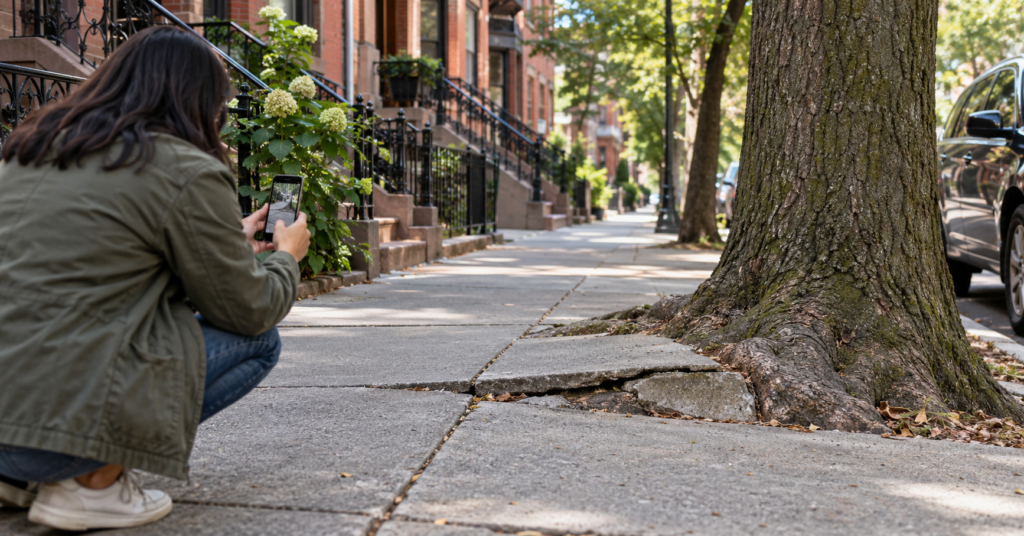
Do not assume that every lifted sidewalk flag beside a tree qualifies as tree-root damage. The elevation could also result from soil movement, poor drainage, utility work, construction settlement or deterioration around a driveway.
Signs suggesting root-related movement include:
- A raised sidewalk flag next to a street-tree bed
- Cracking that follows the direction of visible roots
- Pavement lifting toward the tree rather than sinking away from it
- A tree bed that has become too small for the trunk and root flare
- Repeated displacement after earlier surface repairs
- Roots visibly extending beneath the affected concrete
Photograph the tree, tree bed, sidewalk and surrounding area from several angles. Include a ruler or level when documenting the height difference. Save the date of each photograph and avoid moving markings placed by city inspectors.
A homeowner can submit a request through NYC311 for the sidewalk to be evaluated under the Trees and Sidewalks Repair Program. Parks—not the homeowner or contractor—determines whether the damage qualifies as city-tree-related.
Properties Eligible for the Trees and Sidewalks Program
The Trees and Sidewalks Repair Program is intended for sidewalks damaged by curbside tree roots beside one-, two- and three-family residential properties. Eligibility does not guarantee immediate construction.
After receiving a request, NYC Parks may inspect the location and assign a priority based on the severity of the defect and other site conditions. The timing of a city-funded repair depends on available funding, the location’s priority and competing needs within the district.
Homeowners can review NYC’s current Trees and Sidewalks Repair guidance before submitting a request. The page explains both the city program and the process for arranging an independent repair.
The program generally addresses pavement damaged by a city tree. It may not cover unrelated defects elsewhere along the property frontage. If part of the sidewalk was damaged by roots and another section failed because of age or construction, the work may be divided between city responsibility and owner-arranged repairs.
What Happens After a Parks Inspection
A Parks inspection does not always lead directly to construction. The site may be accepted into the program, placed on a waiting list or found ineligible.
The inspection result should identify whether city-tree roots contributed to the defect. Preserve the service-request number and any written determination because this information may be useful when communicating with DOT, an insurer, a buyer or a contractor.
Homeowners can use the Parks Department’s Tree Work Hub to review information about certain tree-service activities, including sidewalk repairs.
An accepted request means the site qualifies for consideration under the program. It does not necessarily provide a guaranteed repair date. A homeowner facing an immediate safety problem, pending property sale or insurance deadline may need to evaluate the independent-repair process rather than waiting indefinitely.
Understanding a Sidewalk Violation
A sidewalk violation is a notice identifying defects that require attention. It is not the same as a fine. However, the violation is filed with the county clerk and remains associated with the property until it is dismissed.
Common cited defects can include:
- Uneven or raised sidewalk flags
- Cracks and missing pavement
- Improper slopes
- Trip hazards
- Patchwork that does not meet city requirements
- Hardware or other objects protruding from the walking surface
The city’s Sidewalk Violation and Repair page allows owners to learn how to obtain a copy of a violation, dispute a recent notice, complete repairs and request dismissal.
If the owner believes the condition was incorrectly classified or the notice identifies the wrong property, the owner should follow the dispute procedure promptly. NYC311 states that an owner requesting an appeal of a new violation may receive a reinspection by a different inspector. The results of that second inspection are treated as final.
The 75-Day Period After a Violation
Owners of residential properties with three or fewer units should pay close attention to the 75-day period described in the city’s repair guidance.
If repair work has not started within 75 days after a violation is received, DOT may assign the work to a city contractor. The Department of Finance can then bill the property owner for the repair cost. The violation itself does not carry a fine or penalty, but city-completed construction is not necessarily free when the owner is responsible for the defect.
Tree-related conditions require additional care. Before assuming that the ordinary 75-day repair path applies, confirm whether Parks has classified the defect as damage caused by a city tree and which agency will handle the affected sidewalk flags.
Keep records of every 311 request, inspection result and conversation. A timeline can help demonstrate that the owner responded promptly even when different agencies are involved.
Independent Repairs Require Two Main Permits
A homeowner does not have to wait for the city program if the condition requires faster attention. An independent repair may be possible, but the owner should not hire a crew to remove concrete around a city tree without the required approvals.
For qualifying tree-related work, the usual process includes:
- Hiring a contractor experienced with NYC sidewalks and street trees
- Obtaining a Tree Work Permit from NYC Parks
- Obtaining a Sidewalk Construction Permit from NYC DOT
- Following the tree-protection instructions issued for the site
- Arranging the required inspections after completion
Parks reviews the tree before issuing its permit and provides directions for completing the repair without harming it. NYC311 states that the Tree Work Permit is generally valid for 90 days.
DOT separately requires authorization for sidewalk construction. The city’s current Sidewalk Construction Permit page explains the permit process and applicable city fees.
The contractor should understand that a street tree is city property. Cutting roots, pruning branches or altering the tree bed without permission can damage the tree and violate permit conditions.
Repair Methods May Vary by Site
Replacing a concrete flag in the same position is not always the best approach when roots have already occupied the space beneath it. Parks may approve a design that provides additional room while preserving a safe pedestrian path.
Depending on the site, an approved solution could involve:
- Enlarging or reshaping the tree bed
- Replacing selected sidewalk flags
- Adjusting the pavement grade
- Using approved flexible materials
- Bridging over roots
- Rerouting a portion of the sidewalk
- Combining tree-bed work with concrete replacement
The appropriate design depends on sidewalk width, root location, tree condition, accessibility requirements, nearby utilities and the amount of pedestrian space that must remain.
A contractor should not promise a specific treatment before Parks reviews the tree. The least expensive concrete proposal may become unusable if it depends on cutting structural roots.
Requesting Dismissal After the Repair
Completing the physical work does not automatically clear a sidewalk violation from the property record. The owner must complete the required sign-off and dismissal process.
For tree-related repairs, Parks may inspect the completed work to confirm that the permit conditions were followed and the tree was protected. DOT may also need to conduct a dismissal inspection.
Before requesting dismissal, gather:
- The sidewalk permit number
- The property address
- Block and lot information
- The violation number
- Contractor invoices
- Before-and-after photographs
- Parks sign-off or related tree documentation
- Contact information for scheduling the inspection
Do not cover the work or leave equipment blocking the area that must be inspected. Confirm that every cited defect included in the repair scope is visible and corrected.
After the violation is dismissed, retain the confirmation with the property’s permanent records. This can prevent confusion during refinancing or a future sale.
When the City Tree Is Not the Only Cause
A street tree and sidewalk defect may occupy the same area without the tree being responsible for every problem.
For example, the tree may have lifted one flag while another flag cracked because of a deteriorated driveway apron. Water from a downspout could also wash out soil beneath part of the pavement. Utility cuts and earlier patchwork may create additional defects.
Request that the inspection and contractor proposal separate:
- Flags displaced by city-tree roots
- Ordinary concrete deterioration
- Driveway-related damage
- Utility-related openings
- Drainage or settlement problems
- Defects outside the tree’s root zone
This distinction helps the homeowner understand which work may qualify for city assistance and which portion remains an owner expense.
NYC Sidewalk Tree Damage and Insurance Risk
A sidewalk condition can attract an insurer’s attention even when the homeowner is waiting for a city response. Insurers may evaluate exterior hazards during underwriting, renewal or a property inspection. A raised sidewalk flag can be treated as a potential trip-and-fall exposure.
Possible insurance consequences depend on the carrier and policy, but they may include:
- A request for photographs or repair documentation
- A deadline for correcting the condition
- Restrictions imposed at renewal
- A premium change
- Nonrenewal or cancellation subject to applicable rules
- Questions after a liability claim
Acceptance into the Trees and Sidewalks Repair Program may not satisfy an insurer if no repair date has been scheduled. Send the insurer the Parks inspection result, service-request number, photographs and any contractor or permit records. Ask exactly what evidence is required and the deadline for providing it.
Do not describe the condition as resolved merely because a request has been submitted. Give the insurer an accurate update showing what has happened and what remains pending.
Sidewalk Liability Depends on the Property
New York City’s sidewalk liability rules contain an important distinction for certain small residential properties.
Section 7-210 of the NYC Administrative Code generally places potential liability for injuries caused by unsafe adjoining sidewalks on property owners. However, an exception applies to one-, two- and three-family residential properties that are owner-occupied, in whole or in part, and used exclusively for residential purposes.
That exception should not be interpreted as permission to ignore dangerous pavement. It may not apply if the property is entirely tenant-occupied, contains a nonresidential use or otherwise fails to meet the statutory requirements. Insurance policies and repair obligations must also be considered separately.
Owners uncertain about their property’s classification or potential exposure should speak with a New York attorney and their insurance carrier. A general article cannot determine how the law applies to a particular accident or building.
What to Do After a Trip-and-Fall Report
If someone reports falling on the affected sidewalk, respond carefully. Do not argue about fault or promise payment.
The owner should:
- Check whether the person needs emergency assistance
- Photograph the location as soon as possible
- Preserve security-camera footage
- Record the weather and lighting conditions
- Save earlier photographs and inspection records
- Note the exact location identified by the person
- Notify the insurance carrier promptly
- Avoid altering evidence before it is documented
Emergency safety measures may still be necessary, but temporary cones, tape or patching should not replace a properly permitted repair. Any temporary action should avoid obstructing pedestrian access or damaging the tree.
Filing a Claim After Paying for Tree-Related Repairs
NYC311 states that an owner who pays to repair a sidewalk damaged by a city tree may file a claim with the City of New York. Claims are handled through the Comptroller’s Office.
Filing does not guarantee reimbursement. The claim will be reviewed, and the city may accept, deny or offer to settle it based on the circumstances and supporting evidence.
Preserve:
- The Parks inspection or tree determination
- Permit applications and approvals
- Detailed contractor invoices
- Proof of payment
- Photographs showing the root-related damage
- Photographs of the completed repair
- Inspection and sign-off records
- Correspondence with city agencies
A vague invoice stating only “sidewalk repair” may be less useful than an itemized record connecting the work to the affected tree and specific sidewalk flags.
Selling a Home With a Sidewalk Violation
An unresolved sidewalk violation can complicate a sale even though it is not a monetary fine. Buyers, attorneys and title professionals may want to know who will complete the repair and pay the resulting cost.
Possible transaction solutions include:
- The seller completing the work before closing
- Holding funds in escrow for the repair
- Negotiating a purchase-price credit
- Assigning responsibility in the contract
- Delaying closing until the violation is dismissed
- Providing documentation that the site is awaiting city work
A pending Trees and Sidewalks request should not be presented as a guaranteed free repair by a specific date. The parties should address what happens if the city does not perform the work or completes only the root-damaged portion.
Owners preparing for a sale may also find PropertyTale’s guide to NYC property management costs useful when reviewing recurring property obligations. Buyers evaluating other location-specific closing risks can read about California home insurance contingencies.
NYC Sidewalk Tree Damage Checklist
When tree roots appear to be lifting the sidewalk:
- Photograph the tree, roots and affected flags
- Submit a Trees and Sidewalks request through NYC311
- Save the service-request number
- Confirm whether the tree is city-owned
- Review any DOT violation immediately
- Note all appeal, repair and insurance deadlines
- Avoid cutting roots or removing concrete without permits
- Ask the insurer what documentation it requires
- Compare the city-program timeline with an independent repair
- Keep permits, invoices, photographs and sign-offs
- Request formal dismissal after completing repairs
Frequently Asked Questions
Who repairs a sidewalk damaged by a city tree in NYC?
Eligible one-, two- and three-family residential properties may qualify for a free repair through the NYC Parks Trees and Sidewalks Repair Program. Eligibility and timing depend on a Parks inspection, available funding and repair priority. Owners may also arrange permitted independent repairs.
Is a sidewalk violation a fine?
No. NYC explains that a sidewalk violation does not carry a fine or penalty. It identifies defects requiring correction and remains filed until dismissed. If DOT performs owner-responsible repairs, the owner may be billed for the work.
Can a homeowner cut tree roots to level the sidewalk?
Not without authorization. Street trees are managed by NYC Parks, and root cutting can harm or destabilize a tree. Tree-related sidewalk work generally requires a Parks Tree Work Permit and a DOT sidewalk permit.
How long does the free city repair take?
There is no universal completion date. The timing depends on funding, the severity of the defect and the priority of other requests in the district. Acceptance into the program should not be confused with a scheduled construction date.
Can sidewalk damage affect homeowners insurance?
Yes. An insurer may view uneven pavement as a liability risk and request repairs or supporting documentation. The exact response depends on the company, policy and condition of the sidewalk.
Does repairing the sidewalk remove the violation automatically?
No. The owner must complete the applicable inspection and dismissal process. Keep the permits and sign-offs showing that the work met DOT and Parks requirements.
Property Note: This article provides general educational information and is not legal, insurance or construction advice. New York City procedures, permit fees and eligibility standards can change. Property owners should verify current requirements through NYC311, NYC Parks, NYC DOT, their insurer and qualified professionals before starting work.