
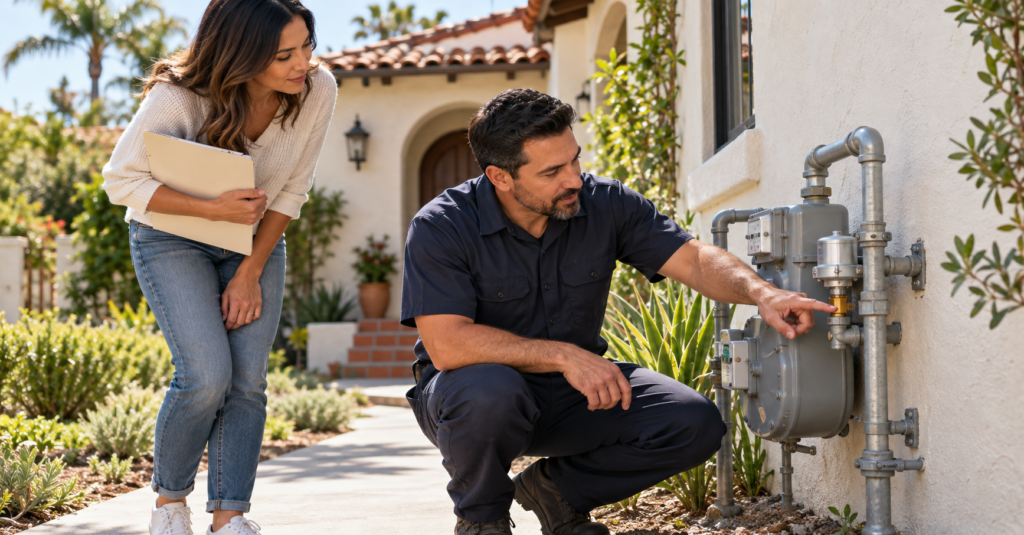
Los Angeles home sales can involve a gas-valve compliance issue even when the stove, furnace, and water heater appear to work normally. Buyers and sellers need to establish whether the property has the required automatic shutoff protection and whether the available records support that conclusion.
This is a specific check involving the building’s gas piping, the installed device, and the approval process. Addressing it early gives the parties time to investigate an existing installation or arrange necessary work before the transaction reaches its deadline.
Confirm that the City of Los Angeles rules apply
Start by confirming the property’s jurisdiction. This article concerns City of Los Angeles requirements; do not automatically apply them to every property in Los Angeles County.
The city’s requirements when selling property identify seismic gas shutoff valves or excess-flow shutoff valves as required equipment for buildings containing fuel gas piping.
Under the city’s sale provision, installation is required before entering into a sale agreement or, where an escrow agreement has been executed in connection with the sale, before escrow closes.
Ask the transaction team to confirm how that requirement applies to the property. An electric kitchen does not establish that the building has no fuel gas piping. A gas furnace, water heater, fireplace, or other part of the system may still need consideration.
Identify the type of shutoff device
The presence of a valve near the meter is only a starting point. Different devices respond to different conditions.
A manual shutoff valve requires someone to operate it. An earthquake-sensitive automatic valve responds to shaking above its design threshold. An excess-flow automatic valve responds when downstream gas flow exceeds its designed trigger level.
California’s Division of the State Architect explains these distinctions in its gas shutoff device comparison.
Consequently, a standard manual valve does not establish that the automatic-valve requirement has been satisfied. Neither automatic design should be described as detecting every possible gas leak.
Have a qualified professional identify the device rather than relying on its color, shape, or a seller’s general description of an “earthquake valve.”
Check which gas lines the valve serves
The next question is whether the identified device covers the relevant piping.
The city’s sale provision specifically addresses condominium units: the required protection must serve all gas piping supplying the individual unit being sold. Seeing a valve elsewhere in the building does not establish that it protects that unit.
For a condominium purchase, ask the association or building manager for access to the relevant meter area and available installation records. Confirm whether any proposed work requires association coordination.
A house with an accessory dwelling unit or several meters deserves similar attention. Ask the installer to identify the arrangement and explain which lines each device serves.
For example, paperwork referring to one meter on a two-meter property leaves a question about the second system. Resolve that question before accepting a general statement that the entire property is covered.
Review an existing installation before ordering replacement
Ask the seller for the installation date, device identification, installer details, and available approval records. Clear photographs of the valve and its markings can help the reviewing professional match the equipment to the documents.
The Division of the State Architect’s certification guidance distinguishes product certification from local oversight of installation, permitting, and inspection.
A state-certified device therefore does not, by itself, establish that its installation satisfies the city’s requirements. Have the professional check the model, location, mounting, and applicable local approval.
If records are missing, identify what evidence LADBS will accept before deciding on corrective work. Likewise, ask how the rules apply to an older installation instead of assuming that age alone requires replacement.
Establish the correct permit and approval process
Before work begins, ask the installer and LADBS which permits, inspections, or authorized certification procedure apply to the proposed installation.
For work following the regular permit process, LADBS states that the installation is not approved until it has been inspected and accepted. Its inspection guidance explains the distinction between obtaining permission to perform work and securing approval of the completed installation.
If a contractor proposes an alternative certification process, have LADBS confirm that it applies to the particular work and property. Ask which certificate must be filed and how its filing will be documented.
Do not treat an ordinary contractor’s invoice as interchangeable with those records.
Keep the permit number or applicable certification reference in the transaction file. Where corrections are required, assign someone to track their completion and obtain the resulting approval.
Price the complete job and assign responsibility
A useful estimate describes the entire scope, including the device, installation labor, necessary piping changes, applicable fees, and the approval process. Ask whether a return visit for corrections is included.
Also clarify access arrangements, any expected interruption to gas service, and responsibility for coordinating restoration. These details can matter when tenants occupy the property or equipment sits in a shared area.
Buyers and sellers should document who orders the work, who pays, and when the required evidence must reach the closing team.
A negotiated credit changes the financial arrangement between the parties. It should not be assumed to satisfy or postpone a city installation requirement. Have the agent or attorney address that distinction before either side agrees to handle the work after closing.
Avoid relying on a general promise that the issue will be resolved “through escrow.”
Match sale disclosures to the supporting records
The city also requires sellers of residential property to obtain and deliver a Report of Residential Property Records, commonly called a Form 9 or Residential Property Report.
When preparing the sale file, make sure statements about the gas-valve installation reflect what has actually been established. If the work is incomplete, describe its status accurately rather than presenting a scheduled appointment as a completed installation.
Identify whether an unresolved item concerns the device itself, coverage of a particular line, or missing approval documentation. This gives the parties a specific problem to address.
For Los Angeles home sales involving several units, use consistent unit and meter references across the contractor’s paperwork and the transaction records. An unexplained mismatch should be investigated while the seller and installer remain available.
Include operating information in the handover
Once the installation and approval questions are resolved, ask the seller to provide the device’s operating information, warranty documents, and relevant service records.
The buyer should know where the equipment is located and whom to contact if it activates or appears damaged. Ask the qualified installer to explain any owner responsibilities and the appropriate procedure for restoring service.
Do not trip, shake, bypass, or reset a valve merely to demonstrate it during a walkthrough. Leave testing and gas-system work to qualified personnel.
Keep the installation and approval documents with the property’s permanent maintenance records so they remain available for future servicing or a later sale.
Note: This article provides general information, not legal advice or gas-installation instructions. Confirm current requirements for the property with LADBS and use appropriately qualified professionals for gas-system work.