
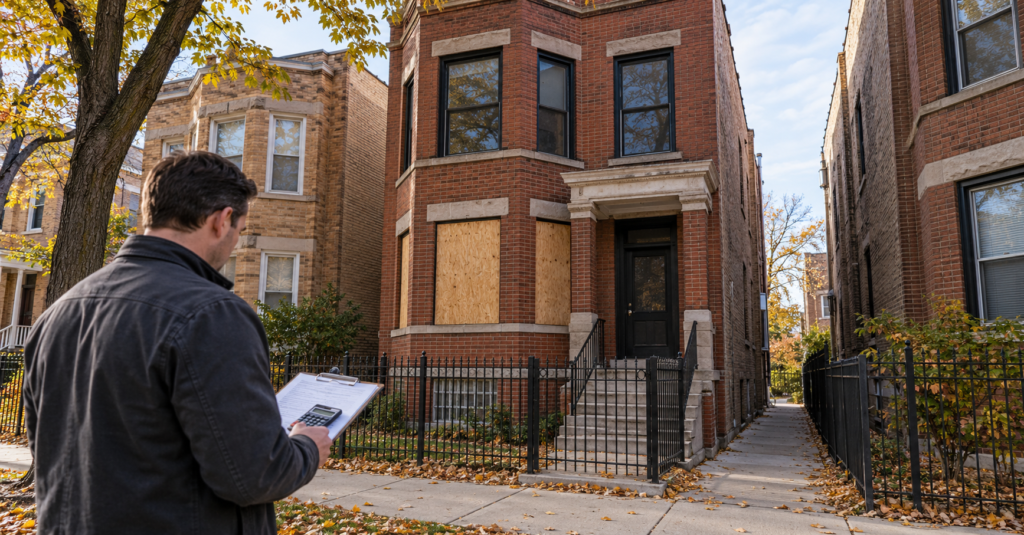
Chicago vacant buildings can produce expenses long before they generate rent. An investor may budget carefully for acquisition and renovation while leaving too little cash for the period between taking ownership and achieving lawful occupancy.
That gap involves more than loan payments. Registration, insurance, property security, routine care, and unexpected delays each affect the amount needed to hold the investment.
The useful starting point is a property-specific vacancy plan: establish which rules apply, investigate existing problems, and calculate how the budget changes if the project takes longer than expected.
Determine whether the building qualifies as vacant
An empty apartment does not automatically place an entire building in the same regulatory category.
The city’s vacant-building FAQs explain that, for residential buildings with fewer than ten units, the assessment considers lawful occupancy and whether a former resident intends to return within six months. For buildings with ten or more units, at least 90% being unoccupied can trigger the vacant-building classification.
A vacant storefront within an otherwise occupied building has separate requirements. Confirm the correct category before using a fee schedule or assuming an exemption applies.
Also explain any construction activity to the Department of Buildings. Planned renovation alone does not establish the status of a property; permit-related exceptions depend on the circumstances. Keep evidence supporting the classification used.
Investigate the existing enforcement history before buying
Review the property’s records while negotiating the purchase.
Chicago’s vacant-building registry allows public searches for registered properties and pending enforcement information. The separate building permit and inspection records system provides another part of the history.
Ask the seller for notices, inspection reports, court documents, permits, and evidence that required corrections were accepted. Have the attorney handling the purchase determine what unresolved orders, fines, or liens mean for the transaction.
A permit entry does not establish that the work was completed correctly. Likewise, the absence of a violation in an online search should not replace a physical inspection and document review.
Turn each unresolved condition into an estimated cost and a scheduling question before finalizing the investment budget.
Put registration and renewal dates on the calendar
As listed in the city’s owner guidance for 2026, timely voluntary vacant-building registration costs $30. The initial fee is $100 when registration follows the city identifying a violation of the vacant-building requirements. Registrations renew every six months; the city currently lists a $30 voluntary renewal fee.
These are owner-registration figures. Vacant-storefront and mortgagee registrations use different schedules. Confirm the applicable amount when filing, especially for renewals in later years.
For a building already vacant when purchased, the owner-registration deadline is generally 30 days after acquisition. Keep the vacancy and closing dates in the file, and do not assume the seller’s account completes the new owner’s obligations.
Assign one person to monitor renewal notices and keep contact information current. Include any cost of local representation or administrative support in the holding budget if the ownership arrangement requires it.
Allow for security costs that change over time
Securing the building is an ongoing task.
Chicago’s vacant-building owner requirements state that plywood boarding is limited to the first six months of vacancy. After that, openings need an acceptable longer-term closure. Existing secure doors and windows in good condition may remain in place.
For an investor, the important date is when vacancy began. Purchasing a building that has already been empty for several months should not be treated as restarting the plywood period.
Have the property inspected for unsecured openings and obtain a scope covering appropriate repairs or replacements. Ask whether enhanced security measures apply to its condition or history.
Budget for follow-up visits and damage response as well as the initial installation. A single board-up invoice does not account for the cost of keeping a property secure throughout a delayed project.
Obtain insurance based on the actual vacancy and work
The city requires liability insurance for vacant buildings. Discuss that obligation separately from coverage for physical damage to the property.
Give the insurer accurate information about occupancy, the expected vacancy period, construction plans, existing damage, and security arrangements. Ask for written confirmation of what the proposed policy covers and any conditions that must be followed.
Useful questions include how the policy addresses theft, vandalism, water damage, renovation work, and an extended completion date. Also confirm whether the lender has additional requirements.
Compare the premium, deductible, and relevant exclusions. A lower premium may still leave an exposure the investor cannot comfortably fund.
Include the cost of extending or changing coverage if the project remains vacant longer than planned.
Assign routine property care to specific people
The absence of tenants does not eliminate maintenance.
The city’s owner guidance calls for regular visits, property upkeep, and appropriate maintenance or winterization of plumbing and heating systems. Exterior responsibilities include keeping the property clean and addressing snow on adjacent sidewalks.
Create a written scope for the person checking the building. Specify the visit schedule, photographs required, reporting process, and authority to arrange urgent work.
Price seasonal tasks separately where needed. Snow removal, grounds care, pest treatment, and debris removal may follow different schedules and billing arrangements.
Have qualified professionals determine the appropriate utility and freeze-protection plan. Include the power needed for security equipment or other systems that remain operational.
The goal is to know who will notice a problem and how quickly it can be addressed.
Test the budget against a longer holding period
Use monthly allocations to compare scenarios, even when some bills are paid quarterly or annually.
The following example is hypothetical and does not represent Chicago market quotes:
| Holding expense | Illustrative monthly amount |
|---|---|
| Interest-only financing | $1,600 |
| Property-tax allocation | $450 |
| Insurance allocation | $200 |
| Utilities | $200 |
| Property checks | $175 |
| Grounds care and cleanup | $125 |
| Total | $2,750 |
At these assumed amounts, a four-month hold costs $11,000. Extending the period to seven months raises it to $19,250, an additional $8,250.
Registration charges, one-time security upgrades, renovation work, and leasing expenses are additional in this example.
If the lender collects tax and insurance escrows, avoid counting those amounts twice. Also distinguish forgone rent from cash actually leaving the account: both affect the investment, but they serve different purposes in a cash-reserve calculation.
Build the delayed scenario around realistic remaining steps, such as inspections, corrections, financing, and tenant move-in.
Close the registration when the qualifying event occurs
Chicago vacant buildings require administrative follow-through when the holding period ends.
The city instructs owners to deregister within 20 days after the building is reoccupied, demolished, or sold. Keep confirmation with the property records.
Before placing tenants, resolve applicable occupancy restrictions and required approvals. Signing a lease or completing cosmetic work does not, by itself, answer whether the building can lawfully be occupied.
Coordinate any change in insurance and property-care arrangements with the actual transition. Retain final invoices, approval records, and dated photographs so the next stage of ownership begins with a clear record of the building’s condition.
Note: This article provides general information, not legal, tax, insurance, or investment advice. Verify current City of Chicago requirements for the specific property and obtain professional advice before purchasing or changing its occupancy.