
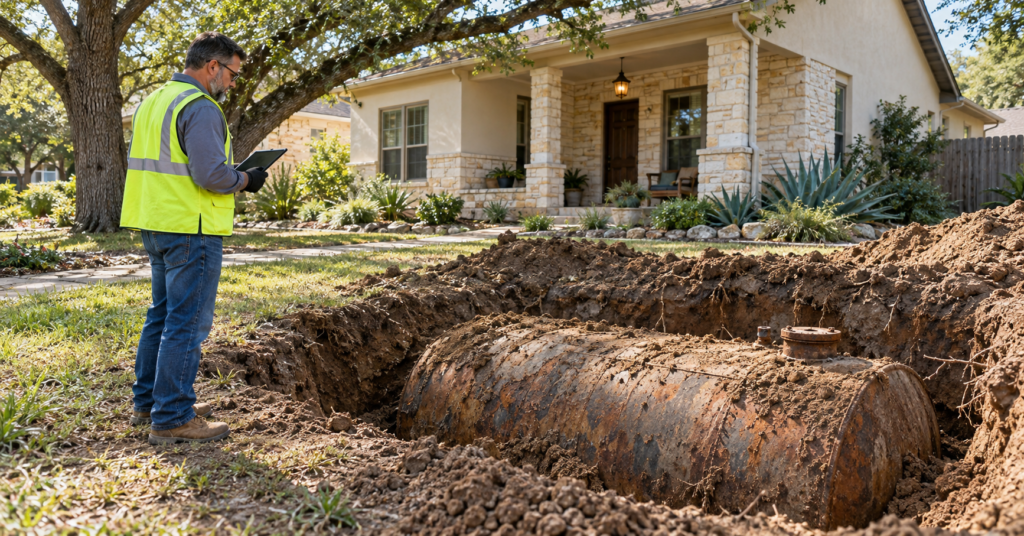
San Antonio homes with buried oil tanks need a closer review before buyers commit to removal costs or accept a seller’s explanation that the equipment is no longer used. The questions extend beyond whether a tank remains underground: buyers also need to understand its contents, previous work, and the condition of the surrounding land.
A practical investigation starts with the property’s history and ends with a documented decision about the purchase. Texas disclosure forms, environmental guidance, San Antonio permit information, and aquifer maps can each help answer a different part of that investigation.
Establish What the Tank Stored
Begin by asking what the tank supplied and when it was last used. Request records identifying its capacity, construction, location, and any connected piping.
The description “oil tank” may be incomplete. Heating fuel, used oil, and other stored substances raise different questions about testing and regulation. A propane tank also requires a different assessment. If the seller cannot identify the contents, have a qualified specialist determine how to investigate.
Ask about the property’s former uses as well as its heating history. An outbuilding or earlier activity on the land may explain an installation that has no connection to the current heating system.
Compare old photographs and site drawings with today’s layout. Note whether a driveway, patio, or addition now occupies the tank area, and whether records suggest more than one tank.
Review the Seller’s Knowledge and Supporting Documents
The Texas Real Estate Commission’s Seller’s Disclosure Notice includes a question about aboveground or underground storage tanks. The notice reflects the seller’s knowledge and expressly states that it does not replace inspections a purchaser may want.
Read the answers and attached explanations together. A disclosed tank with no description of its condition warrants follow-up.
Request records of previous leaks, repairs, pumping, removal, or environmental work. If the seller inherited the property or bought it after the tank stopped being used, establish which statements come from documents and which are assumptions.
Where a seller is exempt from providing the notice, discuss the information gap with your agent or attorney. The absence of a disclosure form does not resolve the physical condition of the property.
Understand What a Standard Home Inspection Covers
A satisfactory home inspection does not establish that land around a buried tank is free of contamination.
TREC’s inspection standards describe the minimum inspection as a limited visual survey. They do not require inspectors to inspect buried items or perform environmental testing.
For San Antonio homes with buried oil tanks, ask whether a separate specialist assessment is needed and obtain its scope in writing. Locating equipment, checking its integrity, and investigating a possible release are different tasks.
If soil sampling is proposed, request an explanation of the sample locations, substances tested, and limitations. The professional should also identify areas that could not be investigated.
Have the results interpreted in relation to the tank’s history and the property layout. A laboratory result answers questions about the samples submitted; its significance depends on whether the investigation adequately addressed the suspected problem.
Confirm the Tank’s Status Under Texas Rules
The Texas Commission on Environmental Quality lists heating-oil tanks among common exemptions from petroleum storage tank rules. Its guidance also explains that underground tanks storing used oil generally fall under petroleum storage tank requirements.
Have the professional reviewing the property identify the category that applies to this installation. Do not assume that every tank at a house has the same regulatory status.
An exemption from a particular tank rule does not establish that the equipment is sound or the surrounding land is uncontaminated. It also does not settle separate local requirements.
If investigation reveals a release, ask TCEQ which reporting and cleanup provisions apply to that situation. The tank’s use and the findings should guide that discussion.
Check San Antonio Permit Requirements Before Scheduling Removal
The San Antonio Fire Department lists an Underground Storage Tank Removal or Installation Permit on its permits and inspections page.
Ask the contractor to confirm whether the proposed work requires that permit, which inspections must be arranged, and what information must accompany the application. Establish who will handle those steps before agreeing to a completion date.
Check the property’s actual jurisdiction. A San Antonio mailing address or listing description should not substitute for confirming which authority oversees the site.
The contractor’s plan should address utility locating, excavation access, and protection of nearby buildings. If the seller proposes filling the tank in place, ask the relevant authority whether that approach is permitted and what documentation it requires.
Review the Edwards Aquifer Location
Aquifer protection deserves a separate check because the applicable requirements depend on where the property and proposed work are located.
TCEQ identifies the Edwards Aquifer as a drinking-water source for San Antonio and surrounding communities. Its fractures, caves, and other openings can allow pollution to reach groundwater.
The agency’s Edwards Aquifer Protection Program provides maps of regulated zones and guidance on approvals. TCEQ also identifies its San Antonio regional office as the contact for assistance in Bexar County.
Have the environmental professional review the parcel and proposed excavation area. Ask whether aquifer-related requirements affect the work and whether any approval is needed before it starts.
Keep that determination with the project records. Being near a regulated zone and being inside one are different circumstances that should be resolved using the mapped boundaries.
Verify What Previous Tank Work Accomplished
Statements such as “the tank was emptied” or “everything was taken care of” need supporting records.
An invoice for pumping documents the removal of contents. A removal receipt documents a different activity. Neither document, by itself, describes the full condition of surrounding soil.
Request the complete project file, including site drawings, photographs, laboratory results, disposal documentation, and any relevant agency correspondence. Confirm that the records identify the same property and tank.
TCEQ’s petroleum storage tank records and datasets provide access to historical and current information about registered tanks and known leaking tanks. Use those records alongside local files and the seller’s documents. A search with no matching record should not be treated as proof that no tank existed.
For regulated releases, TCEQ’s cleanup guidance addresses the leaking equipment and affected soil or groundwater. Have the specialist explain any unfinished work or qualifications in a previous cleanup determination.
Compare the Full Costs Before Accepting a Credit
An estimate should explain what is included, what remains uncertain, and how additional work would be charged.
Ask for separate allowances for pumping, cleaning, excavation, testing, transportation, disposal, and restoring the disturbed area. Clarify whether the proposal includes investigating contamination discovered during removal.
Access can materially change the scope. A tank beneath paving may require demolition and replacement, while one close to a foundation may require a different excavation plan.
Evaluate a seller credit against those conditions. A credit based solely on removing the tank may leave additional investigation and restoration unaccounted for.
Also give the insurer and lender accurate information about the tank. Ask the insurer about relevant coverage and exclusions, and ask the lender which reports it needs before financing can proceed.
Set Clear Conditions for Completing the Purchase
Use the findings to negotiate a written agreement that identifies the work, responsible parties, payment arrangements, and required completion documents.
Address discoveries that could expand the project. If contaminated soil is found, the agreement should explain who arranges further assessment and how the additional work affects the closing schedule.
Coordinate investigations with any option period or other deadlines in the purchase contract. Ask a Texas real estate attorney to review access arrangements, proposed extensions, and the available choices if results remain incomplete.
Keep the final reports after closing. They can help answer questions when planning construction, reviewing insurance, or preparing disclosures for a future sale.
Note: This article provides general information for San Antonio homebuyers, not individualized legal, environmental, or insurance advice. Requirements depend on the property’s jurisdiction, tank use, location, and investigation findings.