
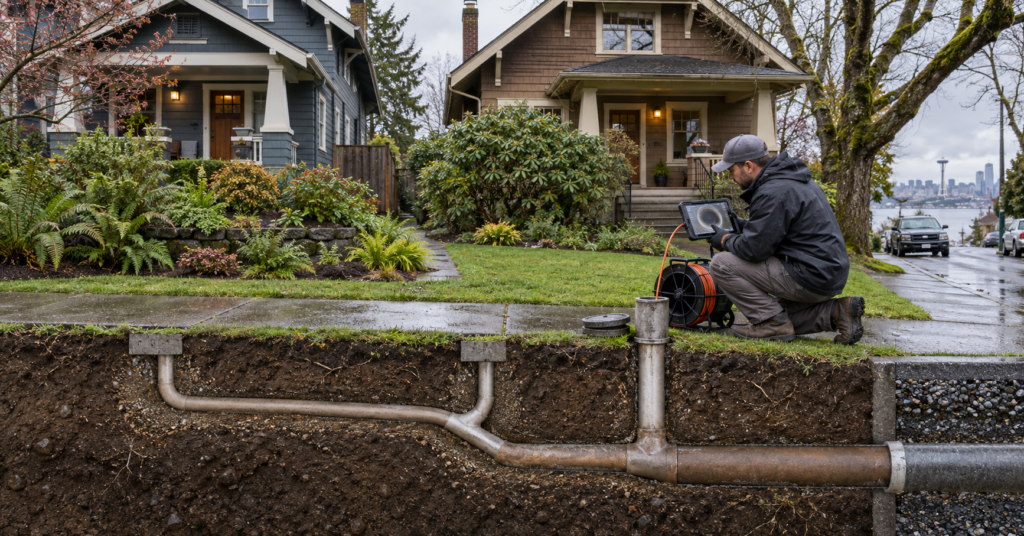
Seattle shared side sewers can expose homebuyers to repair costs, access disputes and maintenance obligations that may not be obvious during an ordinary home inspection. Before closing, buyers should confirm where the sewer runs, which properties use it, who maintains each section and whether a recorded agreement explains how expenses are divided.
A standard home inspection normally does not show the complete condition of an underground sewer pipe. Buyers may need a separate camera scope, city sewer records and a review of the property’s title documents to understand the potential risk.
The existence of a shared line is not automatically a reason to reject a property. The concern is uncertainty. A clearly documented, functional shared system may be manageable, while a deteriorated line with no recorded agreement could leave a new owner negotiating with neighbors during an urgent backup.
Quick Answer: What Should Buyers Check?
Before buying a Seattle property connected to a shared side sewer, check:
- The route from the house to the public sewer main
- Every property connected to the shared section
- The pipe’s material, age and visible condition
- Roots, cracks, offsets, bellies and standing water
- Whether the camera reached the public connection
- Recorded easements and maintenance agreements
- Past permits, repairs and replacement work
- Access points and cleanout locations
- Responsibility for repair costs
- Whether the line crosses neighboring property
- Whether buildings, trees or retaining walls obstruct access
- Estimates for any recommended work
- How discovered defects affect the purchase agreement
Buyers should retain the complete sewer video and written findings. A short verbal statement that the line “looks fine” provides little help if a dispute develops later.
What Is a Seattle Side Sewer?
A side sewer is the privately owned pipe that carries wastewater from a building to the public sewer system. Some properties have an individual line serving only one structure. Others connect with neighboring properties before reaching the public main.
Seattle Public Utilities explains that property owners are generally responsible for maintaining and repairing their side sewers, including removing roots up to and within the connection to the public sewer. That responsibility can extend into the public right-of-way even though the owner does not own the street.
The city maintains the public sewer main. Determining precisely where a defect is located is therefore important. A problem in the private side sewer may be the property owner’s responsibility, while a defect in the public main may require city involvement.
Buyers can review the city’s explanation of side sewer defects and owner responsibilities.
What Makes a Side Sewer “Shared”?
A shared side sewer serves two or more properties. Each building may have an individual branch that connects to a common private pipe before that pipe reaches the public sewer main.
The arrangement might look like this:
| Sewer section | Properties using it | Possible responsibility |
|---|---|---|
| Individual branch from House A | House A only | Usually associated with House A |
| Individual branch from House B | House B only | Usually associated with House B |
| Combined section after the branches join | Houses A and B | May involve both properties |
| Public sewer main | Many properties | Maintained by the public utility |
This table illustrates a common arrangement, but it does not determine legal responsibility for a particular property. Recorded agreements, title documents, permits, sewer records and the specific location of the defect may affect who must perform or pay for the work.
Some shared configurations involve more than two homes. Others may cross several parcels or pass beneath a neighboring yard before reaching the street.
Why Shared Side Sewers Create Additional Risk
An owner with a private line can usually decide when to clean, repair or replace it, subject to permits and access requirements. A shared line introduces other people into that decision.
Potential complications include:
- Owners disagreeing about whether a repair is necessary
- Disputes over how costs should be divided
- One owner refusing access to the affected area
- Uncertainty about which property caused a blockage
- A defect located beneath a neighbor’s yard
- Landscaping or structures obstructing excavation
- Different owners preferring different repair methods
- An emergency occurring before responsibility is resolved
- No written agreement governing maintenance
- An agreement that does not address the current configuration
The financial exposure may extend beyond the pipe itself. Excavation can disturb pavement, sidewalks, landscaping, fences, driveways or retaining features that may also require restoration.
Search Seattle’s Side Sewer Records
Seattle Public Utilities provides tools that allow property owners, buyers and developers to research water and sewer infrastructure.
A buyer should start with the city’s Water and Sewer Map and available side sewer records. These may show the approximate route, connection location, pipe details or historical work associated with the property.
Older side sewer cards are useful starting points, but buyers should not treat every historical drawing as a precise modern survey. Site conditions may have changed, additions may have been built and old records may contain limited measurements.
Compare the city record with:
- The sewer-scope video
- Visible cleanouts
- The property survey
- Title documents
- Seller disclosures
- Permit history
- The location of buildings and landscaping
- Information provided by neighboring owners
If the records and physical findings conflict, ask for clarification before removing the inspection contingency.
Order an Independent Sewer Scope
A sewer scope uses a camera to inspect the interior of an accessible drain or sewer pipe. The operator should attempt to follow the line from an appropriate access point to the public connection when conditions allow.
For a shared sewer, the inspection should identify:
- Where the property’s individual branch begins
- Where it joins another private line
- Which portion is shared
- Whether the camera reaches the public main
- The approximate location and depth of defects
- Pipe material and transitions
- Available cleanouts
- Areas that could not be inspected
Buyers should consider hiring their own qualified inspector instead of relying exclusively on a seller-provided report. An older report may not reflect current conditions, and its scope may not have covered the entire shared section.
Property Tale’s guide to what to look for during a house viewing can help buyers identify broader warning signs before ordering specialized inspections.
Defects a Sewer Scope May Reveal
A sewer camera cannot reveal every underground condition, but it may identify problems that justify additional evaluation.
Root intrusion
Tree and shrub roots can enter through cracks and pipe joints. Cutting the roots may temporarily restore flow without correcting the opening that allowed them to enter.
Ask whether the recommendation is periodic cleaning, lining, spot repair or complete replacement. The answer may depend on the pipe’s condition rather than the presence of roots alone.
Cracks and broken pipe
Visible fractures can allow soil or groundwater into the line and wastewater out of it. The severity depends on the crack’s location, size and effect on the pipe.
Offset joints
One section of pipe may shift relative to the next. A significant offset can restrict flow, collect debris or prevent the camera from completing the inspection.
Bellies or low sections
A low area can retain water and waste instead of allowing consistent gravity flow. Ask the inspector to estimate the belly’s location and whether it appears to interfere with drainage.
Corrosion or deterioration
Older metal pipes may corrode, while clay or concrete materials may crack, separate or become vulnerable at their joints.
Obstructions and grease
A blockage may be removable, but buyers should determine whether it resulted from ordinary buildup, improper use, structural damage or inadequate slope.
Cross connections or undocumented branches
The scope may reveal another property joining the line in a location that does not match available records. This is particularly important when evaluating Seattle shared side sewers.
Confirm Where Every Defect Is Located
The words “root intrusion” or “cracked pipe” are not enough. The buyer needs to know where the condition exists.
Ask the inspector to locate significant defects at the surface when possible. The report should identify the approximate distance from the access point, depth and nearby reference features.
This helps determine whether the defect is:
- Inside the building
- On the property’s individual branch
- Within the shared section
- Under a neighboring parcel
- In the public right-of-way
- At or near the public sewer connection
- Inside the public main
Location affects access, permitting, repair method, restoration costs and the parties who may need to participate.
Review Easements and Maintenance Agreements
A shared sewer crossing another parcel may be supported by a recorded easement. The easement can grant rights to use, access, maintain or replace the line.
A separate joint-use or maintenance agreement may address:
- Which properties can use the sewer
- Who may enter land to perform work
- How advance notice must be given
- How routine maintenance costs are divided
- How emergency repairs are authorized
- How replacement costs are allocated
- Who restores disturbed landscaping
- Whether insurance is required
- How disputes are handled
- Whether the agreement binds future owners
A buyer should not assume that an easement automatically contains a complete cost-sharing system. Some easements provide access but say little about maintenance. Others may describe a route that no longer matches the physical line.
A qualified Washington real estate attorney or title professional can explain what the recorded documents mean for the specific purchase.
What If No Written Agreement Exists?
An undocumented shared sewer deserves additional investigation. It does not necessarily mean the arrangement is unlawful or unusable, but the buyer may face uncertainty about access and cost sharing.
Before closing, consider asking:
- How long has the shared arrangement existed?
- Have the neighboring owners acknowledged it?
- Who paid for previous cleaning or repairs?
- Are invoices or correspondence available?
- Does the title report disclose an easement?
- Does the physical line cross a parcel without recorded access rights?
- Can an agreement be completed and recorded before closing?
- Will the lender or title insurer raise concerns?
- Would separating the line be technically feasible?
A casual understanding between current neighbors may not protect a buyer after ownership changes.
Examine the Permit History
Seattle requires side sewer permits for covered work on private property or in the public right-of-way. Buyers should check whether previously claimed repair or replacement work appears in the available permit record.
Seattle Public Utilities provides information about side sewer permits, including when permits are required.
Review:
- Permit issuance and completion
- Approved plans or as-built records
- Inspection results
- Work descriptions
- Contractor information
- Whether the permit covers the entire claimed replacement
- Whether work in the right-of-way received necessary authorization
A seller may describe a sewer as “replaced” when only a short section was repaired. Compare invoices, permits, plans and camera footage to determine what was actually completed.
Identify Obstacles Above the Pipe
The condition of the pipe is only part of the repair-risk analysis. The surface above it can significantly affect access and restoration.
Look for:
- Mature trees
- Driveways
- Sidewalks
- Patios
- Retaining walls
- Fences
- Garages or additions
- Utility lines
- Steep slopes
- Neighboring landscaping
- Limited equipment access
A repair beneath an open yard may be different from work beneath a retaining wall or shared driveway. A camera scope should therefore be evaluated alongside the site layout.
Ask for More Than One Repair Scenario
When the scope identifies a defect, request a written assessment explaining the available approaches rather than assuming the most expensive or least expensive option is appropriate.
Possible approaches may include:
- Cleaning or root removal
- Continued monitoring
- Localized spot repair
- Pipe lining
- Pipe bursting
- Conventional excavation
- Separating a property from the shared line
- Replacing the shared section collectively
Not every method works for every pipe. Material, diameter, collapse, offsets, slope, access and connection configuration can affect feasibility.
Written estimates should explain:
- The work included
- The section being repaired
- Permit responsibility
- Excavation and disposal
- Street or sidewalk restoration
- Landscaping restoration
- Inspection and testing
- Warranty terms
- Conditions that could change the price
Property Tale’s article on how to audit repairs handled by a property manager also offers useful principles for comparing invoices, repair descriptions and completion evidence.
Decide How to Address the Risk in the Purchase
After reviewing the sewer scope and records, buyers may have several options depending on the contract and market conditions.
They might:
- Proceed without requesting changes
- Request additional investigation
- Ask the seller to complete permitted repairs
- Request a closing credit
- Negotiate a price adjustment
- Require a written shared-maintenance agreement
- Establish an escrow arrangement
- Request documentation from neighboring owners
- Exercise an inspection right when permitted by the contract
A credit may provide flexibility, but the buyer assumes the risk that actual work costs more than expected. Seller-completed repairs may reduce the immediate burden but leave the buyer with limited control over contractor selection and repair design.
Any agreement should clearly identify the affected sewer section, required documentation and completion standards.
Do Not Rely on Insurance Assumptions
Buyers should not assume homeowners insurance will pay for every side sewer problem. Coverage can depend on the cause of loss, location of damage, policy language, endorsements and exclusions.
Ask an insurance professional about:
- Service-line coverage
- Sewer backup coverage
- Damage to the underground pipe
- Interior damage resulting from a backup
- Excavation and restoration
- Shared-line complications
- Coverage limits and deductibles
- Pre-existing damage exclusions
Insurance availability does not eliminate the need to investigate a known defect before purchasing the property.
Red Flags That Require More Investigation
A buyer should pause and ask additional questions when:
- The seller refuses a sewer scope
- The camera cannot reach the public main
- The report identifies an unexplained shared connection
- City records conflict with the observed route
- No easement or maintenance agreement can be found
- The pipe crosses neighboring land without documented access
- Roots return soon after cleaning
- The line contains significant standing water
- A repair estimate excludes surface restoration
- Prior work appears to lack required permits
- Neighbors disagree about responsibility
- A structure has been built over the line
- The seller cannot explain recurring backups
These conditions do not all require the buyer to cancel. They indicate that the cost and responsibility are not yet clear.
Seattle Shared Side Sewer Buyer Checklist
Before closing, a buyer should be able to answer the following questions:
| Question | Evidence to obtain |
|---|---|
| Is the side sewer shared? | Camera footage and city records |
| Which properties use it? | Sewer map, side sewer card and physical inspection |
| Where does the shared section begin? | Located sewer-scope findings |
| What condition is the pipe in? | Recent independent inspection report |
| Who maintains each section? | Recorded agreement and legal review |
| Can workers access the line? | Easement, survey and site review |
| Were earlier repairs permitted? | Permit and inspection records |
| Is work currently recommended? | Written professional opinion |
| What could the work include? | Detailed repair proposals |
| How will costs be divided? | Agreement, contract or negotiated resolution |
| Does the purchase contract address it? | Attorney-reviewed purchase documents |
If several answers remain uncertain, the buyer has not completed meaningful sewer due diligence.
Frequently Asked Questions
Are shared side sewers common in Seattle?
They exist throughout the city, particularly where older development patterns or property configurations caused multiple buildings to connect to a common private line. Buyers should verify the configuration for the individual property rather than assuming it is private or shared.
Who pays to repair a shared side sewer?
Responsibility can depend on which section failed, which properties use that section, recorded agreements, title rights and other facts. Seattle Public Utilities illustrates shared-responsibility configurations, but a property-specific legal review may be needed when owners disagree.
Does the city repair a side sewer under the street?
Property owners are generally responsible for their private side sewer, including portions within the public right-of-way. The city maintains the public sewer main. The defect must be accurately located before responsibility can be evaluated.
Does a normal home inspection include a sewer scope?
Usually, a sewer camera inspection is a separate service. Buyers should confirm exactly what their inspection package includes.
Is a clean sewer scope enough?
A favorable scope reduces uncertainty but does not necessarily confirm easement rights, cost-sharing obligations, exact pipe location or future performance. Buyers should also review city and title records.
Can a shared sewer be separated?
It may be technically possible to install an independent connection, but feasibility depends on the property layout, elevation, public-main location, permits and construction cost. A qualified professional should evaluate the site.
Should a buyer walk away when roots are found?
Not automatically. The buyer should determine the severity, location, cause, recommended remedy and likely responsibility before deciding how to proceed.
Verify the Pipe and the Paperwork
Seattle shared side sewers require two kinds of due diligence: inspecting the physical pipe and reviewing the documents that govern its use.
A camera scope may reveal roots, cracks or an unexpected connection, but it will not necessarily explain who has access rights or how repair costs must be divided. City records and recorded agreements may describe the arrangement, but they cannot confirm the pipe’s present condition.
Buyers should connect all the evidence before closing. When the pipe, records and title documents tell different stories, that inconsistency deserves further investigation by qualified Seattle sewer, title and legal professionals.
Property Note: This article provides general educational information and is not legal, engineering, plumbing, insurance or real estate advice. Sewer configurations, ownership rights and permit requirements vary by property. Buyers should verify current Seattle requirements and obtain advice from qualified professionals before closing.